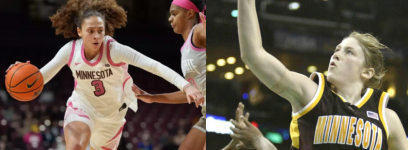
This is a longer one. Stick to the other threads if you want brief.
Drawing on this comment about current expert outlook: https://gopherhole.com/boards/threads/week-of-2-23-bracketologies.121113/
Current Expert Projections (as of Feb 26, 2026)
| Source | Projected Seed | Status |
|---|
| CBS Sports | #4 Seed | Host (Fort Worth 1 Subregional) |
| ESPN (Charlie Creme) | #5 Seed | Next in line (#17 overall) |
Autumn Johnson
(NCAA) | #5 Seed | Next in line (#18 overall) |
| The Athletic (NYT) | #4 Seed | Host (NET Rank: #8) |
Path to Hosting (Top 16 Seed) in NCAA Tournament
To secure a #4 seed or better and host at Williams Arena, Minnesota likely needs to achieve a
24–7 overall record. Here are the key scenarios:
- The "Strong Case" Scenario: Beat Illinois and win at least one game in the Big Ten Tournament to reach the semifinals. Experts suggest a 24–7 finish with a semifinal appearance would likely be enough for a top-16 seed.
Projected Top 4 Seeds (Double-Bye) in Big Ten Tournament
| Seed | Team | Conference Record | Status |
|---|
| 1 | UCLA | 17–0 | Clinched #1 Seed |
| 2 | Iowa | 13–3 | Control own destiny for #2 |
| 3 | Michigan | 13–3 | Tied with Iowa; Iowa holds tiebreaker |
| 4 | Minnesota | 12–5 | Projects to #4 with a win |
Projected Big Ten Tournament Seeds (5–15)
The following teams occupy the single-bye and first-round slots for the tournament beginning March 4 at Gainbridge Fieldhouse:
- #5 Ohio State: Dropped to 12–5 in conference play after losing to Michigan. Because Minnesota holds the head-to-head tiebreaker, the Buckeyes are currently the top single-bye seed.
- #6 Maryland: Currently 11–6. The Terrapins have won six straight games to climb into this spot.
- #7 Michigan State: Also 11–6; they recently beat Minnesota and are neck-and-neck with Maryland.
- #8 Illinois: Currently 9–7. They host Minnesota on March 1 in a game with major seeding implications.
- #9 Washington: Sits at 9–8. They hold a slim lead over USC due to recent results.
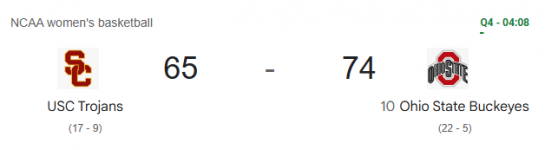
- #10 USC: Now 9–8 after back-to-back losses to Ohio State and Penn State.
- #11 Oregon: Currently 8–9. They remain a lock for the tournament field.
- #12 Nebraska: Sits at 6–11; they have struggled recently, losing two of their last three.
- #13 Indiana: Currently 5–12. They are fighting to improve their resume for an at-large NCAA bid.
- #14 Wisconsin: Also 5–12; likely to play in the Wednesday opening round.
- #15 Penn State: Currently 4–13 after their upset win over USC kept their postseason hopes alive.
Note: The bottom three teams (Purdue, Northwestern, and Rutgers) are currently projected to miss the 15-team tournament field.
Projected Quarterfinal Opponent - Big Ten Tournament
As the #4 seed, Minnesota's first game would be on
Friday, March 6, against the winner of the Thursday "Second Round" game featuring the #5 seed.
- Most Likely Opponent: #5 Ohio State
Following their loss to Michigan, Ohio State (12–5) has fallen into a tie with Minnesota for the final double-bye spot. Because Minnesota holds the head-to-head tiebreaker, if the Gophers beat Illinois, Ohio State is pushed to the #5 seed.
- The Path to the Quarterfinal:
To reach the Gophers, the #5 seed must first defeat the winner of a Wednesday "First Round" game, which typically features lower seeds like #12 Nebraska or #13 Indiana.
Potential Big Ten Quarterfinal Matchup (Friday, March 6)
| Seed | Team | Scenario |
|---|
| #4 Minnesota | Golden Gophers | Double-bye to Quarterfinals |
| #5 Ohio State | Buckeyes | Must win on Thursday to face Minnesota |
| #12 Nebraska | Cornhuskers | Must win Wednesday AND Thursday to face Minnesota |
Likely Big Ten Tournament Semifinal Opponent
UCLA (unless they were upset by opponent in semifinals, likely opponent Illinois or USC)
Big Ten Tournament Tournament Structure for 2026
The 2026 tournament features a
15-team field following conference expansion.
- Wednesday (First Round): Seeds #10–15 compete.
- Thursday (Second Round): Seeds #5–9 enter, playing against Wednesday's winners.
- Friday (Quarterfinals): The top four seeds (UCLA, Michigan, Iowa, and Minnesota) debut against the Thursday winners.
Who is the Bigger Threat to Minnesota: Maryland or Ohio State?
The Verdict: The Terrapins are currently playing "their best basketball" according to head coach Brenda Frese. While Ohio State is the higher seed (#5),
Maryland currently represents the more dangerous statistical threat.
No. 14 Maryland is currently playing its best basketball of the season, entering late February on a
six-game winning streak. Their style of play is defined by high-intensity pressure and a dominant interior presence.
Performance Breakdown
- Transition Game: Maryland thrives when they can push the pace. Head coach Brenda Frese recently emphasized that their transition game is at its best when they apply defensive pressure. In their December 100–99 win over Minnesota, Maryland exploited this, outscoring the Gophers 29–11 in fast-break points.
- Paint Scoring: The Terrapins are a "paint-first" team. They consistently outmuscle opponents inside, as seen in their February 25 win over Northwestern where they outscored the Wildcats 54–38 in the paint. They averaged 54 paint points in their first matchup with Minnesota as well.
- Winning Streak: Maryland has "caught fire" in February, rattling off six consecutive victories. This streak includes a major 76–75 comeback win over then-#8 Ohio State.
Gophers in the NCAA Tournament
Potential First-Round Matchups
Based on current bracketology for February 26, 2026, here are the most likely opponents the Gophers would face in Minneapolis:
- Gonzaga (WCC Champion): CBS Sports currently projects Gonzaga as the #13 seed in the same region where they have Minnesota as a #4 seed.
- Florida Gulf Coast (ASUN Champion): A perennial "giant killer" often found on the 12 or 13-seed line.
- Drake or South Dakota State: Both regional mid-major powers are currently projected in the 12–14 seed range and could be moved to Minneapolis for geographic proximity.
- Other Potential 13-Seeds: Recent projections from ESPN and NCAA.com include teams like Cleveland State (Horizon), North Texas (AAC), or Ball State (MAC).
The Second-Round Scenario
The winner of the #4 vs. #13 game faces the winner of the
#5 vs. #12 matchup. If the Gophers advance, potential second-round opponents hosted at Williams Arena could include:
- #5 Seed: Teams currently on this line include Kentucky, LSU, or Maryland.
- #12 Seed: High-performing mid-majors like Middle Tennessee or UNLV.
Historical Context: 4 vs. 13
While #4 seeds are heavy favorites, #13 seeds have historically won about
21% of first-round matchups in the women's tournament. Notable recent upsets include Yale over Auburn (2024) and Portland over various higher seeds.
Finally, there are many games left to play. Lots can happen. This is meant to provide some clarity. Could be wrong. Gophers have to sustain a winning streak.
Illinois Up Next
Illinois enters the March 1 regular-season finale as a formidable opponent with a
19–8 overall record (9–7 in the Big Ten). Under fourth-year coach Shauna Green, they have specialized in high-efficiency offense and marquee upsets, including a historic top-10 victory over Maryland earlier this season.
Illinois is a team that
lives almost entirely in the half-court. They are widely considered one of the slowest teams in the country, prioritizing a deliberate and physical style of play over fast-break opportunities.
Transition Offense: A Major Weakness
- Minimal Fast-Break Scoring: Illinois generates only 6.4% of its points on the fast break. This ranks them 361st out of 365 teams nationally, indicating an almost total lack of transition offense.
- Lack of Disruption: The Illini do not force many turnovers, ranking among the worst in Division I for opponent turnover rate and steals. Because they don't create "chaos" defensively, they rarely get the steals necessary to ignite a fast break.
Half-Court Offense: Their Bread and Butter
- Deliberate Execution: Illinois plays a "slow" and "disciplined" game, often using a large portion of the shot clock to hunt for high-quality shots.
- Interior Focus: Their half-court sets revolve around exploiting their positional size, particularly in the paint, where they often dominate scoring margins.
- Offensive Rebounding: Instead of running back on defense or pushing for quick shots, they often crash the offensive glass to extend possessions in the half-court.
How They Win: Explosive Offense & Paint Dominance
- High-Octane Scoring: Illinois ranks among the nation's elite offenses, averaging 77.9 points per game (27th in NCAA).
- Interior Control: They frequently dominate the "points in the paint" battle, outscoring recent opponents like Northwestern 54–38 and Washington 44–22 near the basket.
- Perimeter Accuracy: When their inside game is established, they become lethal from deep; they recently set a season-high with 12 made three-pointers on 66.7% shooting.
- Cleaning the Glass: A primary pillar of their success is offensive rebounding. They often convert second-chance opportunities into double-digit scoring advantages (e.g., 26 second-chance points vs. Washington).
Key Matchup: Minnesota's
#21 ranked scoring defense will be tested by Illinois’ elite interior scoring.
Why This Matters for Minnesota
In the March 1 regular-season finale, Minnesota's No. 21-ranked scoring defense will face an Illinois team that won't try to outrun them. The game will likely be a
physical, half-court battle where the Gophers must focus on post-defense and limiting Illinois' second-chance points rather than defending the fast break.
Why Illinois Lost: Defensive Lapses & Overtime Struggles
- Defensive Consistency: Their scoring defense is ranked significantly lower than their offense (192nd in NCAA), often allowing opponents to "dice up" their rotations and find open lanes.
- Late-Game Execution: Illinois has struggled to close out tight contests, losing several games this season in overtime (including back-to-back OT losses to Michigan State and Wisconsin).
- Physicality & Energy: In late-season losses, the team has appeared to "run out of energy," struggling with defensive answers when key players log heavy minutes or when opponents outmatch their physicality on the boards.