ESPN Way-Too-Early 2026 Bracketology

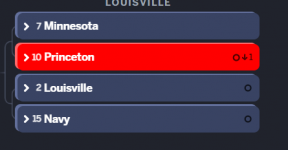
ESPN Bracketology has the Gophers still on the 7 seed line; however, I think they moved spots (of the 7 seeds) Last week they had them playing in Baton Rouge with a potential second round game against LSU. Today they have them sitting in Louisville region. Opening up against #10 Villanova.

Keep winning and it will all work out! Go Gophs!
 

Kind of an interesting thought: If MSU loses at home to UCLA on Weds. and Iowa loses at home to Washington (possible), and the Gophers can beat Nebraska, the Gophers would technically have sole possession of 4th place in the BIG. They'd have a better conference record than MSU and they'd have a half-game lead and a tiebreaker advantage over the Hawkeyes. Gophers could really benefit from getting a double bye in the BIG tourney.
A double bye would be great.
I would take win over Nebraska, a lose by MSU and Washington, moving us into sole possession of 5th.
 

I know some people don't like these kinds of info dump.posts:

Based on the Gophers' current resume, recent performance, and advanced metrics as of mid-February 2026, here is the projected NCAA Tournament seeding:

Projected Seed: #6 or #7

(With a realistic chance to climb to a #5)

The "Why" Behind the Projection

If I were in the committee room, here is the case for this seed:
  • The "Metrics" Darling (NET Ranking):The most surprising and positive factor for Minnesota is their NET ranking, which sits incredibly high (hovering around #10 in the country). The NCAA Selection Committee relies heavily on the NET. Typically, a top-10 NET ranking correlates with a #3 or #4 seed. However, Minnesota's seed will likely be slightly lower than their NET because they don't have as many "Quad 1" wins as the other top teams, but this number provides a very high floor.
  • The Signature Win:The recent road upset over #10 Iowa was massive. That is exactly the kind of "resume-topping" victory the committee looks for to validate a team's high metrics.
  • Current Momentum:They are on a 6-game winning streak (as of Feb 10, 2026). The committee often values how a team is playing right now rather than how they played in November.
  • Big Ten Standings:At 9-4 in conference play (18-6 overall), they are tied for 5th place in what is arguably the toughest conference in the country. Finishing in the top 5 of the Big Ten virtually guarantees a single-digit seed.

Best & Worst Case Scenarios

  • Ceiling (Best Case): #4 Seed.If they win out the rest of the regular season and make a deep run in the Big Ten Tournament (reaching the semis or finals), they could steal a #4 seed. This is significant because top-4 seeds host the first two rounds of the NCAA tournament at home (at Williams Arena).
  • Floor (Worst Case): #8 or #9 Seed.If they struggle down the stretch and lose their remaining tough games, they could fall back to the 8/9 line. This is the "danger zone" because it means facing a #1 seed (like UConn or South Carolina) in the second round.

Following their recent road win at Rutgers, the team is currently on a six-game winning streak and holds an 18–6 overall record (9–4 in Big Ten play).

Remaining Regular Season Schedule

Date OpponentLocationTime (CST)
Feb 12, 2026Nebraska CornhuskersWilliams Arena
(Home)
7:00 PM
Feb 15, 2026Wisconsin BadgersKohl Center
(Away)
5:00 PM
Feb 18, 2026Ohio State BuckeyesWilliams Arena
(Home)
7:00 PM
Feb 22, 2026Michigan State SpartansWilliams Arena
(Home)
5:00 PM
Mar 01, 2026Illinois Fighting IlliniState Farm Center
(Away)
2:00 PM

NCAA Tournament Logic and Projections

The logic for Minnesota's projected NCAA Tournament seed is currently driven by their strong NET Ranking (No. 10) and a significant recent road win against No. 10 Iowa.
  • Resume Logic:
    • Winning Streak: Their current 6-game streak in a top-tier conference is a major positive indicator for the selection committee.
    • Strength of Schedule: The remaining games against high-ranking Big Ten teams like Ohio State (currently 2nd in Big Ten) and Michigan State (5th) offer opportunities to climb even higher in seed projections.
    • Bracketology: Experts suggest a second-round bye in the Big Ten tournament is likely, which traditionally correlates with a mid-to-high single-digit seed in the NCAA field.
Failure to maintain this momentum against upcoming ranked or high-NET opponents could lead to a slide toward the "Bubble," as seen in previous seasons. However, their current top-10 NET ranking suggests they are currently in a very strong position to host or receive a favorable seed.
 

FYI

For the 2026 NCAA Women's Basketball Tournament, the first and second-round games (March 20-23, 2026) will be played at campus sites hosted by the top 16 seeds.

The tournament begins with the bracket reveal on March 15, 2026, leading up to the Final Four in Phoenix, Arizona.
  • First Four: March 18-19, 2026, in Dayton, Ohio.
  • First & Second Rounds: March 20-23, 2026, hosted at top 16 campus sites.
  • Regional Sites (Sweet 16/Elite Eight): March 27-30, 2026, in Fort Worth, Texas (Dickies Arena) and Sacramento, California (Golden 1 Center).
  • Final Four: April 3 & 5, 2026, at the Mortgage Matchup Center in Phoenix, Arizona.
Tournament Field Composition
The 68-team field is composed of two primary types of entries:
  • 31 Automatic Bids: Awarded to the champions of each Division I conference.
  • 37 At-Large Bids: Selected by the NCAA Division I Women’s Basketball Committee based on regular-season performance and metrics.
Tournament Structure
  • The First Four: The tournament begins with the "First Four" games, featuring the four lowest-seeded automatic qualifiers and the four lowest-seeded at-large teams. The winners of these four games advance to the main 64-team bracket.
  • The Bracket: Once the field is narrowed to 64, teams are divided into four regions, each consisting of 16 teams seeded 1 through 16.
The official bracket for the 2026 tournament will be revealed on Selection Sunday, March 15, 2026, at 8 p.m. ET on ESPN.

The large number of conferences exists to organize hundreds of schools based on factors like geographic proximity, school size, and athletic budget. They are generally categorized into two groups:
  • Power 4 Conferences: These are the largest and most prominent leagues—the ACC, Big Ten, Big 12, and SEC. While they only account for 4 of the 31 automatic bids, they typically receive the majority of the 37 at-large bids because of their high level of competition.
  • Mid-Major and Small Conferences: The remaining 27 conferences (such as the Patriot League, Sun Belt, or Ivy League) ensure that schools from all regions and resource levels have a designated pathway to the national tournament.

For the 2026 tournament, the 31 conferences receiving automatic bids include:
  • Major/Multi-Bid Leagues: ACC, Big Ten, Big 12, SEC, Big East, and American (AAC).
  • Mid-Major/Single-Bid Leagues: Atlantic 10, Mountain West, Sun Belt, West Coast (WCC), MAC, Missouri Valley (MVC), and others such as the Horizon League, Ivy League, and SWAC.
The only way for a team in a smaller conference to make the tournament is often by winning their conference tournament, as they rarely receive the "at-large" bids reserved for top-performing teams that didn't win their league title.
 
Last edited:

Autumn Johnson, one of the more prominent Big Ten Network analysts, put out a new bracket today and has Minnesota as a 5 seed. I'd gladly take that!


Top Bottom