Revenue share: stop feeding the football furnace

Wet_Blanket_Guy

Well-known member
Joined
Mar 13, 2019
Messages
1,567
Reaction score
1,297
Points
113
Alright, dusting off the old Wet_Blanket_Guy account. Yes, that one. No, I’m not here to apologize. I’ve always been a Gopher fan — I just refuse to pretend every decision out of that building is automatically brilliant.

I watched my first Gopher game of the year when they played at Illinois. And a few things were immediately obvious:
  • This roster is severely undermanned… and yet they can compete for long stretches with real Big Ten teams.
  • They can even pop a big one occasionally (Iowa, Indiana), and they’ve had tight losses (USC, Wisconsin) that weren’t “embarrassing” so much as “we don’t have enough bodies.”
And most importantly:

Niko Medved can coach.
Like, actually coach. The team looks organized. They play connected. They don’t look like five guys freelancing and hoping the other team misses.

Which is why I’m posting today — not to do the usual “rah rah moral victory” thing, but to stir up a conversation about something that actually matters:

How should the President, AD, and GM distribute revenue sharing?

I haven’t seen Minnesota’s exact plan, but most Big Ten / SEC programs are reportedly allocating roughly 75% of revenue share to football. NIL is on top of revenue sharing, not included.

So the practical reality is: Gopher basketball is probably headed toward $4–5M out of roughly $20.5M.

Here’s my argument:

Invert the ratio.
Basketball should get 75%.

Do the math:
  • 75% of $20.5M = $15.375M to basketball before NIL
  • Add NIL on top and call it ~$17M
In basketball, you don’t need a 100-man operation and five layers of “culture.” You need a few high-end players and a coach who can actually use them.

Could you imagine the Barn with a $15.375M roster?
You could sign a rental star if you wanted and still have absurd money left to build a team. The Barn would be rocking again, you’d have real relevance, and the U would actually see a meaningful ROI in energy, ticket demand, and visibility.

Yes, football would get hit. No question.

But let’s stop acting like the current “football-first” approach is taking us anywhere special:
  • We go from 4–6 Big Ten wins to 2–4
  • We still land in some mid-tier bowl nobody watches
  • Attendance probably stays annoyingly steady because football here is habit, not performance-based
And here’s the blunt truth: unless Minnesota is willing to spend $30M+ annually on football, we’re not winning the Big Ten and we’re not making the CFP. So why keep feeding a furnace that doesn’t heat the house?

Basketball is the sport where money can flip outcomes fast.
Now we have a coach who looks like he can actually leverage it.

If you’re going to invest, invest where you can actually win.

Let’s hear it.


From a purely fan standpoint I don't disagree about spending more on basketball. I think the ROI quality is much better and we could instantly compete and make sweet 16+.

From a numbers perspective, if you make the football team feel slighted, you could lose a big amount of revenue since they are the main generator.


The largest ROI is football, so I would think the athletic department would fairly quickly be unprofitable.
I get the theoretical ROI argument for football — but at Minnesota, football ROI is capped. There’s no meaningful upside.

We’re averaging 46,519 in football attendance and it’s fallen two straight years. That’s not a blip, that’s a trend. There’s an entire thread on here documenting it.

Even if we shove more of the $20.5M into football:
  • Best case, we go from 4–6 Big Ten wins to 5–6
  • Still not competing for the CFP
  • Still not winning the conference
  • Still stuck in the same bowl ecosystem
Let’s be generous and assume more spending bumps attendance.

If football somehow sells 5,000 more tickets per game (optimistic), over 7 home games, that’s:
  • 35,000 incremental football tickets
Now look at basketball.

Men’s basketball averaged 8,923 last season.
If real investment + relevance gets that to 13,000, that’s:
  • +4,077 per game
  • Over 19 home games
  • 77,463 incremental basketball tickets
So now the question gets even simpler:

Is a football ticket worth more than a basketball ticket?

Because it would need to be for football to produce better ROI under these assumptions — and that’s before we even talk about:
  • Weeknight vs. weekend density
  • Number of events
  • Barn atmosphere driving repeat attendance
  • Basketball games people actually choose to attend
Football ROI at Minnesota isn’t zero — but it’s bounded. Unless we’re willing to spend $30M+ annually, the upside just isn’t there.

Basketball ROI is elastic. Spend it well, outcomes flip quickly, and attendance responds immediately.

So this isn’t anti-football — it’s just being honest about where the upside lives.

If ROI is the goal, basketball is the better investment.


Alright, dusting off the old Wet_Blanket_Guy account. Yes, that one. No, I’m not here to apologize. I’ve always been a Gopher fan — I just refuse to pretend every decision out of that building is automatically brilliant.

I watched my first Gopher game of the year when they played at Illinois. And a few things were immediately obvious:
  • This roster is severely undermanned… and yet they can compete for long stretches with real Big Ten teams.
  • They can even pop a big one occasionally (Iowa, Indiana), and they’ve had tight losses (USC, Wisconsin) that weren’t “embarrassing” so much as “we don’t have enough bodies.”
And most importantly:

Niko Medved can coach.
Like, actually coach. The team looks organized. They play connected. They don’t look like five guys freelancing and hoping the other team misses.

Which is why I’m posting today — not to do the usual “rah rah moral victory” thing, but to stir up a conversation about something that actually matters:

How should the President, AD, and GM distribute revenue sharing?

I haven’t seen Minnesota’s exact plan, but most Big Ten / SEC programs are reportedly allocating roughly 75% of revenue share to football. NIL is on top of revenue sharing, not included.

So the practical reality is: Gopher basketball is probably headed toward $4–5M out of roughly $20.5M.

Here’s my argument:

Invert the ratio.
Basketball should get 75%.

Do the math:
  • 75% of $20.5M = $15.375M to basketball before NIL
  • Add NIL on top and call it ~$17M
In basketball, you don’t need a 100-man operation and five layers of “culture.” You need a few high-end players and a coach who can actually use them.

Could you imagine the Barn with a $15.375M roster?
You could sign a rental star if you wanted and still have absurd money left to build a team. The Barn would be rocking again, you’d have real relevance, and the U would actually see a meaningful ROI in energy, ticket demand, and visibility.

Yes, football would get hit. No question.

But let’s stop acting like the current “football-first” approach is taking us anywhere special:
  • We go from 4–6 Big Ten wins to 2–4
  • We still land in some mid-tier bowl nobody watches
  • Attendance probably stays annoyingly steady because football here is habit, not performance-based
And here’s the blunt truth: unless Minnesota is willing to spend $30M+ annually on football, we’re not winning the Big Ten and we’re not making the CFP. So why keep feeding a furnace that doesn’t heat the house?

Basketball is the sport where money can flip outcomes fast.
Now we have a coach who looks like he can actually leverage it.

If you’re going to invest, invest where you can actually win.

Let’s hear it.
I love it. But I would not go this big with the idea. I would love to see the Basketball program get another 2 million. I think that would be enough. Niko doesn't need one and done guys, he just needs a bunch of really solid players with skills and length.
 

Fascinating topic considering the fan crossover from Gopher Football to Men's Basketball is probably an extremely high %. I also buy into the concept that funding a potential National Title contender is easier for a hoops program for obvious reasons.

I won't pretend to know how all of this actually works but imagine having a football program properly funded solely by NIL and private donors leaving the entire $20M to fund our hoops, hockey, volleyball, softball, etc.


You can't go 70% to basketball. You can take SOME from football and pump basketball up.
 

Because 95% of Minnesotans don't care about college hockey?
Correct but again if the determining factor is “what people care about” that brings us back to football.

Just looking for some consistent reasoning here. Obviously I don’t actually think significant $ is going to hockey.


My view from 10,000 feet would be to ask what the ultimate big picture goal is. Does the UofM want to win a national title in basketball, and do what it takes to give them a decent shot? OR, Does the UofM want to fairly distribute the revenue across the board to evenly represent the student athletes in their athletics programs, provide equally competitive conference teams across the board in men's and women's sports (ie. win the Capital One Challenge)? With Title 9, the teams have to be distributed equally, but how would the distribution compensate for the non-income generating sports in both men's and women's programs? I have to believe that MN just wants to "compete" on a fairly level playing field instead across the board. There are schools otherwise, but I just don't see MN throwing a bunch of money at one sport.

That said, I would love if they did, or somehow had a major donor--Tyson, FedEx, Nike-type of big business, since the Twin Cities just doesn't have any major Fortune 500 companies... Even getting the money doesn't assure anything. Ex: UCLA/ Memphis spent a ton in bb and hasn't done great.
 

Also, I do believe Coyle has already said he would be allocating more NIL to basketball.


OP is the guy who wrote to the strib every year with the u sport coat rant. The strib ran that letter every effing year
 

My view from 10,000 feet would be to ask what the ultimate big picture goal is. Does the UofM want to win a national title in basketball, and do what it takes to give them a decent shot? OR, Does the UofM want to fairly distribute the revenue across the board to evenly represent the student athletes in their athletics programs, provide equally competitive conference teams across the board in men's and women's sports (ie. win the Capital One Challenge)? With Title 9, the teams have to be distributed equally, but how would the distribution compensate for the non-income generating sports in both men's and women's programs? I have to believe that MN just wants to "compete" on a fairly level playing field instead across the board. There are schools otherwise, but I just don't see MN throwing a bunch of money at one sport.

That said, I would love if they did, or somehow had a major donor--Tyson, FedEx, Nike-type of big business, since the Twin Cities just doesn't have any major Fortune 500 companies... Even getting the money doesn't assure anything. Ex: UCLA/ Memphis spent a ton in bb and hasn't done great.
MN has 17 fortune 500 companies .
 

Alright, dusting off the old Wet_Blanket_Guy account. Yes, that one. No, I’m not here to apologize. I’ve always been a Gopher fan — I just refuse to pretend every decision out of that building is automatically brilliant.

I watched my first Gopher game of the year when they played at Illinois. And a few things were immediately obvious:
  • This roster is severely undermanned… and yet they can compete for long stretches with real Big Ten teams.
  • They can even pop a big one occasionally (Iowa, Indiana), and they’ve had tight losses (USC, Wisconsin) that weren’t “embarrassing” so much as “we don’t have enough bodies.”
And most importantly:

Niko Medved can coach.
Like, actually coach. The team looks organized. They play connected. They don’t look like five guys freelancing and hoping the other team misses.

Which is why I’m posting today — not to do the usual “rah rah moral victory” thing, but to stir up a conversation about something that actually matters:

How should the President, AD, and GM distribute revenue sharing?

I haven’t seen Minnesota’s exact plan, but most Big Ten / SEC programs are reportedly allocating roughly 75% of revenue share to football. NIL is on top of revenue sharing, not included.

So the practical reality is: Gopher basketball is probably headed toward $4–5M out of roughly $20.5M.

Here’s my argument:

Invert the ratio.
Basketball should get 75%.

Do the math:
  • 75% of $20.5M = $15.375M to basketball before NIL
  • Add NIL on top and call it ~$17M
In basketball, you don’t need a 100-man operation and five layers of “culture.” You need a few high-end players and a coach who can actually use them.

Could you imagine the Barn with a $15.375M roster?
You could sign a rental star if you wanted and still have absurd money left to build a team. The Barn would be rocking again, you’d have real relevance, and the U would actually see a meaningful ROI in energy, ticket demand, and visibility.

Yes, football would get hit. No question.

But let’s stop acting like the current “football-first” approach is taking us anywhere special:
  • We go from 4–6 Big Ten wins to 2–4
  • We still land in some mid-tier bowl nobody watches
  • Attendance probably stays annoyingly steady because football here is habit, not performance-based
And here’s the blunt truth: unless Minnesota is willing to spend $30M+ annually on football, we’re not winning the Big Ten and we’re not making the CFP. So why keep feeding a furnace that doesn’t heat the house?

Basketball is the sport where money can flip outcomes fast.
Now we have a coach who looks like he can actually leverage it.

If you’re going to invest, invest where you can actually win.

Let’s hear it.
It would be more like 0-2 wins in football and a long term doormat in the big ten if we did that.


MN has 17 fortune 500 companies .
Minnesota does have one of the highest per capita rates of Fortune 500 companies in the U.S. However, 13 of those are publicly traded and have to answer to shareholders, so donating NIL money to University of Minnesota athletics isn't an option. The 4 private companies have more flexibility to do something like direct support (Land O'Lakes is a great example).
 

Alright, dusting off the old Wet_Blanket_Guy account. Yes, that one. No, I’m not here to apologize. I’ve always been a Gopher fan — I just refuse to pretend every decision out of that building is automatically brilliant.

I watched my first Gopher game of the year when they played at Illinois. And a few things were immediately obvious:
  • This roster is severely undermanned… and yet they can compete for long stretches with real Big Ten teams.
  • They can even pop a big one occasionally (Iowa, Indiana), and they’ve had tight losses (USC, Wisconsin) that weren’t “embarrassing” so much as “we don’t have enough bodies.”
And most importantly:

Niko Medved can coach.
Like, actually coach. The team looks organized. They play connected. They don’t look like five guys freelancing and hoping the other team misses.

Which is why I’m posting today — not to do the usual “rah rah moral victory” thing, but to stir up a conversation about something that actually matters:

How should the President, AD, and GM distribute revenue sharing?

I haven’t seen Minnesota’s exact plan, but most Big Ten / SEC programs are reportedly allocating roughly 75% of revenue share to football. NIL is on top of revenue sharing, not included.

So the practical reality is: Gopher basketball is probably headed toward $4–5M out of roughly $20.5M.

Here’s my argument:

Invert the ratio.
Basketball should get 75%.

Do the math:
  • 75% of $20.5M = $15.375M to basketball before NIL
  • Add NIL on top and call it ~$17M
In basketball, you don’t need a 100-man operation and five layers of “culture.” You need a few high-end players and a coach who can actually use them.

Could you imagine the Barn with a $15.375M roster?
You could sign a rental star if you wanted and still have absurd money left to build a team. The Barn would be rocking again, you’d have real relevance, and the U would actually see a meaningful ROI in energy, ticket demand, and visibility.

Yes, football would get hit. No question.

But let’s stop acting like the current “football-first” approach is taking us anywhere special:
  • We go from 4–6 Big Ten wins to 2–4
  • We still land in some mid-tier bowl nobody watches
  • Attendance probably stays annoyingly steady because football here is habit, not performance-based
And here’s the blunt truth: unless Minnesota is willing to spend $30M+ annually on football, we’re not winning the Big Ten and we’re not making the CFP. So why keep feeding a furnace that doesn’t heat the house?

Basketball is the sport where money can flip outcomes fast.
Now we have a coach who looks like he can actually leverage it.

If you’re going to invest, invest where you can actually win.

Let’s hear it.
Don't totally disagree. Except lets make out of the 20 million for athletes 8 for mens bb, 8 for football, 2..5 for womens bb, .5 for womens vb and 1 million to other athletes. They get another 15-20 million for NIL. 6.5 m for football, 6.25 m for mbb, 1.5 for women bb .3m for womens vb and .3 m womens soccer and .15 m or other athletes. Thats 14.25 m for mbb and 14.5m for football. There is another solutiin though raise more NIL MONEY.
 

Don't totally disagree. Except lets make out of the 20 million for athletes 8 for mens bb, 8 for football, 2..5 for womens bb, .5 for womens vb and 1 million to other athletes. They get another 15-20 million for NIL. 6.5 m for football, 6.25 m for mbb, 1.5 for women bb .3m for womens vb and .3 m womens soccer and .15 m or other athletes. Thats 14.25 m for mbb and 14.5m for football. There is another solutiin though raise more NIL MONEY.


Why can Indiana go from 20 m NIL to 60 M. And dont tell me Mark Cuban. Just as much wealth here among Univ of MN alum as in Indiana.
I do think that if we woulda managed to pop off that 11 win year during the NIL era, wouldn’t have hurt the ol’ NIL budget.


Why can Indiana go from 20 m NIL to 60 M. And dont tell me Mark Cuban. Just as much wealth here among Univ of MN alum as in Indiana.

Indiana football NIL is reported to be around $21 M NIL. Not sure what the 60 M number is. I'm also not sure.

Google AI below on the issue of new Big Ten revenue sharing model -- some don't like seeing posts like this but others like the information, including me:

Begin:
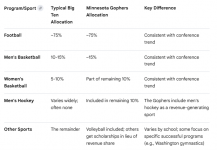
The Minnesota Gophers are splitting their Big Ten revenue share (around $20.5M in 2025-26) heavily towards football (approx. 75%), then men's basketball (~15%), with smaller portions for women's basketball, volleyball, and men's hockey, reflecting football's revenue dominance, while navigating the broader issue of direct athlete pay in college sports post-NCAA settlement. The issue stems from the *House v. NCAA* settlement, allowing schools to share revenue (up to 22.5%) directly with athletes for the first time, shifting from NIL to a "pay-for-play" model.

Minnesota's Revenue Split (2025-26 Estimates)
  • Total: ~$20.5 Million (max allowed by settlement).
  • Football: 75% ($15.4M).
  • Men's Basketball: 15% ($3M).
  • Women's Basketball: ~2%. [EDIT ADD I THINK THIS IS 5%]
  • Men's Hockey: 1% ($1M).
  • Volleyball & Others: Remaining 10%.

The Minnesota Gophers' allocation of revenue sharing funds is typical of most Big Ten schools, with approximately 75% dedicated to the football program. The key difference lies in the Gophers' decision to include men's hockey as a revenue-generating sport receiving a share of the funds, which is not the case for all Big Ten institutions.

The Minnesota Gophers are allocating approximately 15% of their total revenue-sharing funds, or around $3 million, to the men's basketball program, which is consistent with the typical approach of most Big Ten schools. The men's basketball program is also a significant revenue generator and is considered a valuable asset for the university.

Revenue Sharing Allocation
  • Gophers' Plan: The Gophers plan to direct about 15% of their $20.5 million cap to men's basketball, a figure that aligns with the general consensus across the conference.
  • Conference Average: Across the Big Ten, men's basketball programs are expected to receive an average of around 15% of the total revenue-sharing money.
  • Per-Player Average: Because men's basketball rosters are significantly smaller than football rosters, this allocation results in a higher average per-athlete payout for basketball players compared to football players.

Across the Big Ten and other Power Four conferences, a baseline distribution model has emerged, which the Gophers are largely following.


1768964766169.png


The revenue shared directly with student-athletes comes from a combination of the athletic department's existing income sources, primarily media rights (TV contracts), ticket sales, and sponsorships. And yes, these revenue streams are overwhelmingly driven by the football program.


For the Minnesota Gophers, similar to other Big Ten schools, the revenue comes from several "buckets":
  • Big Ten/NCAA Distributions: Over 50% of the Gophers' total athletic revenue comes from payouts from the Big Ten conference and NCAA, primarily the massive media rights deals, College Football Playoff funds, and men's basketball tournament distributions.
  • Ticket Sales: This accounts for another significant portion of income.
  • Fundraising and Sponsorships: Other key revenue streams include donations and corporate sponsorships.

Football as the Primary Driver
Football is the undeniable main source of revenue, both directly and indirectly:
  • Direct Revenue: The Gophers' football program alone is responsible for approximately 75% of the athletic department's total operating revenue. This does not even fully account for the indirect value it generates for media deals.
  • Media Rights Value: The multi-billion dollar Big Ten TV contracts, a primary source of the funds used for revenue sharing, derive most of their value from the ability to broadcast high-demand football and men's basketball games.
  • Profitability: Only football and men's basketball are typically profitable sports.


Mark Cuban and other individually wealthy donors. Companies are not going to fund NIL directly.
My understanding is Cuban helped subsidize Cignetti and the football staff salaries, and thru him and other wealthy alumni donors increased the Nil from 20-60 million which by the way is stll lower than Ohio State, Penn State, Michigan, Oregon, Nebraska, Washingtin and USC have to work with. But my point is if we want to compete in football and basketball and the top female sports the big wealthy alums in this state need to step up. Hell the University of St Thomas and NDSU alums contribute more to athletics and their NILS then the Univ of MN Alums do. We are a fucking disgrace when it comes to that!
 
Last edited:


Top Bottom